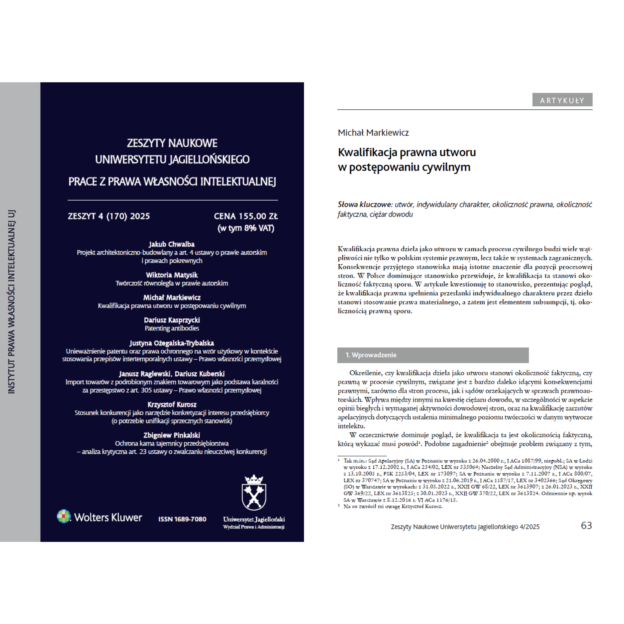
The latest issue of Zeszyty Naukowe Uniwersytetu Jagiellońskiego (ZNUJ) features my article entitled “Legal classification of a work in civil proceedings.” In it, I focus on assessing whether the qualification of fulfilling the prerequisite of “individual character of the work” is a factual circumstance or a legal circumstance of the dispute. The consequences of adopting one or the other concept are far-reaching. For example, recognizing that this is a factual circumstance of the dispute does not allow a cassation appeal to be based on the incorrect classification of a work, while recognizing that this is a legal circumstance excludes the obligation to prove this classification by the defendant (no burden of proof), placing the burden on the court in this regard. In my opinion, the classification of the fulfillment of the individual character requirement constitutes the application of law (subsumption) and is a legal circumstance of the dispute. Consequently, it should be recognized that: 1) the plaintiff is not required to prove that the work fulfills the characteristic of individual creativity; 2) the plaintiff is only required to prove the facts allowing for the assessment of the individual character of the work – in practice, the provision of the original or a copy of the work (or a request for inspection) should be sufficient; 3) there is only a pragmatic expediency (but no obligation) to present to the court indirect facts aimed at directing the court’s attention to those features of the work which, by way of subsumption, it should take into account when applying the law (expediency resulting from the argumentative aspect of the civil dispute); 4) in the case of demonstrating copyright infringement by another entity, the claimant is obliged to indicate the elements of the work taken over by the other entity (factual circumstance), while the qualification of whether these fragments meet the condition of individual character is also incumbent on the court (as a legal circumstance); 5) there is no need to raise an objection of infringement of substantive law in an appeal – the court of second instance is obliged to examine this circumstance ex officio; 6) it is possible to lodge a cassation appeal on the grounds of incorrect qualification of the fulfillment or non-fulfillment of the individual character criterion by the work. Link to the article: https://sip.lex.pl/#/publication/151531666/markiewicz-michal-kwalifikacja-prawna-utworu-w-postepowaniu-cywilnym